


Yet another match between Zeiss and Rokinon. The first was a comparison of fast 35mm primes. This time we’re going to look at a pair of ultra wide-angle primes. A 14mm T3.1 from Rokinon and a 15mm f/2.8 from Zeiss. Some may say it’s an unfair comparison and I would probably agree. It could also be said that Rokinon has something going for them if they’re being compared to an optical giant like Zeiss. In fact, it’s quite the opposite. It’s a testament to the quality of glass that Zeiss has become known for. Zeiss is the standard by which others are measured. Hence, this seemingly unfair comparison. But how unfair is it really? How much performance does your hard-earned money provide with a power-house like Zeiss, over a little Rokinon lens from Gangnam?
The Basics
Let’s start with the biggest and most obvious difference – The price. Zeiss offers their hefty 15mm prime for $2,950. Add the Cine-Mod™ to step up its game to that a cinema lens and you’re at $3,264 for the Zeiss. 

Another primary difference between the two is their construction. The Rokinon uses a cast alloy chassis. The body and barrels of the lens are made from somewhat brittle plastic as well as many of the internal components including focus assembly components. The Zeiss chassis is composed of aluminum alloys and brass focus components. The differences here are arguable since some think that the plastic body may be preferable over a more rigid aluminum body in the event of a fall. The argument being that the plastic body can absorb the impact whereas the aluminum will simply bend a be ruined. This may be true, but one drop from any reasonable height and the plastic components in the Rokinon will all be out of spec and essentially ruined. Basically, any time a lens is dropped, you’re in trouble. 
Optical Performance
Probably a closer comparison than the rest, the optical performance between the Zeiss and the Rokinon are marginal. In resolution tests, both lenses provided 200 lp/mm in the center and in the mid region. The edge is where the Zeiss inched ahead with a reading of 120 lp/mm while the Rokinon was limited to 100 lp/mm. The edge of the field in this case was 35mm full-frame or 24x36mm format. If you’re shooting with a format smaller than 35mm full-frame (24×36) then you probably won’t see much difference in resolution between the two. It’s only when you leave the Super35 frame that you notice a drop off in the Rokinon. The Rokinon exhibited significantly more veiling flare and lower contrast throughout the image than the Zeiss did. The Zeiss had an overall cleaner image with less aberrations and higher contrast – a clear winner (pun intended) in projection tests.

Real world shooting is a bit more forgiving in terms of image quality. Nobody shoots test charts in the real word. And is the difference you see here really worth several thousand dollars more? You be the judge. Here are a few more real world comparison photos to check out.


The close focus of these two lenses is drastically different in terms of wide-angle lenses. Usually with a wide-angle lens you’re aiming for a sweeping panoramic vista or capturing a massive structure in one frame but every now and then an ultra wide-angle is used for that comical close-up distorted look. The closest distance mark on the Rokinon is 1 foot or 0.28 meters. However, the closets I could get the lens to focus is 13″ from the film plane, even with rotation past the labeled minimum of 12″. The Zeiss, however, bests the Rokinon and offers a close focus of a mere 10″ from the film plane. This is a double win for Zeiss because the minimum focus is closer and more accurate.


Speaking of accuracy, the Rokinon has a weird way of focusing. It feels very lost. I can rotate the focus barrel almost 50 degrees and there doesn’t seem to be any change in the actual image. It’s almost as if the focus is disconnected at a certain point on the scale simply to give it a greater rotation. This could be due to sloppy mechanics or it could be a result of a poorly designed focus drive unit. Quite the opposite with the Zeiss, even the slightest rotation gives an instant visual feedback that makes nailing focus extremely easy and quite satisfying. The best way I can think to compare their focusing is the Rokinon reels very random and desensitized whereas the Zeiss gives a feeling of precision and confidence, a sort of direct connection to the optics.

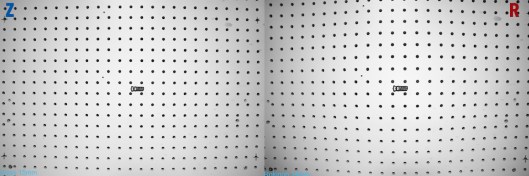

Distortion and vignetting are apparent in both lenses but much more controlled on both accounts in the Zeiss. The barrel distortion is obvious but minimal considering the format coverage and focal length of the Zeiss and a noticeable amount more for the Rokinon. Neither is what I would consider bad or even less than acceptable for such a lens but it’s something to consider.
Mechanics and Build Quality
Obviously at this point you can tell that the Zeiss is of a higher build quality. It uses more exotic materials, has tighter tolerances, and is simply easier to handle. About handling, the Rokinon comes with a few features that the Zeiss lacks. I could overlook these features normally because they can simply be added with the Cine-Mod™ but in this particular comparison, the fact that the Zeiss is almost 8x the price of the Rokinon, it should be noted that there are some features that the Rokinon comes equipped with from the factory. One of the best features is the integrated focus and iris gears. The integrated gears are a nice addition that shows that Rokinon made these specifically for motion picture use and they’re there to make things easier for you. 
Both lenses have an obnoxious but effective integrated sun shade that can’t be removed. At least not easily 😉 The Rokinon has a large bulbous front element that goes all the way to the edge of the sun shade without any filter threads or means of attaching a matte box or filter holder. The Zeiss has a slightly more conservative front element, but an even larger sun shade. The Zeiss does have a 95mm filter thread that accepts Zeiss own UV clear filter as well as some custom ND filters that Duclos Lenses is currently working on. The Rokinon’s plastic sun shade measures ~87mm in diameter which isn’t too large. The Zeiss being a bit beefier is a sometimes cumbersome ~103mm diameter. 
Back to the focus for a moment, focus rotation to be more specific. A lot of shooters are concerned about focus rotation these days and how precise they’ll be able to dial in exact focus. While I agree that a longer focus rotation is very helpful for fine focusing there are a few exceptions to this especially with wide-angle lenses with a deep depth of field such as these. As I mentioned earlier, the Rokinon has an odd focus that is very unresponsive at times and can really make critical focus difficult. The Rokinon is set up with an impressive 300 degree focus rotation, most of which is utterly useless thanks to its lackluster focus movement. The Zeiss has a much shorter focus rotation of about 60 degrees but it’s far more precise and extremely pleasing to nail focus with. It’s an odd somewhat backwards way of thinking since the “more is better” rule usually applies to focus rotation. Not in this instance. Not at all. In fact, even with the 10x magnification for focus assist on my 5D, I’m not entirely sure that I nailed focus on every Rokinon shot.
A Few Other Details
By now you’ve probably gathered that the Zeiss 15mm performs much better than the 14mm. They’re so similar yet so different. Both lenses have about half a dozen focus marks, metric and imperial, on the scale. Both are roughly the same weight 1lb. 4oz. for the Rokinon and 1lb. 10oz. for the Zeiss, which is odd considering the difference in materials. There is a bit of light falloff which is to be expected on such a wide-angle lens that covers a 35mm full-frame format. I don’t have the numbers on light falloff but you can see it in the distortion tests. The Zeiss has a fairly even light falloff which some might even consider pleasing whereas the Rokinon almost has a hot-spot in the middle of the image and then a steep falloff from there that is just about the same as the Zeiss. In this case, it’s not really the amount of light falloff but how it’s distributed that makes a big difference.
As with all lenses, it’s a game of compromise. Wether it’s giving up some performance to save cash or giving up some simple features to gain performance in a particular field. If you’re looking for a lens of this speed and focal length, chances are your decision is going to be based mostly on finances and the choice will be obvious for either end of the spectrum. If you’re looking for that edge that really sets a good lens apart from a great lens you’re probably going to reach for the 15mm Zeiss. If you’re looking for a good lens that will get the shot that you need and don’t want or need to spend thousands on a single prime lens, then I don’t see any reason not to get the Rokinon 14mm. If neither of these options sound good to you, perhaps you should consider the Zeiss CP.2 15mm or the Canon CN-E 14mm. Two more excellent options that blend to world of stills and motion to a degree that offers more options than cinematographers have ever had.