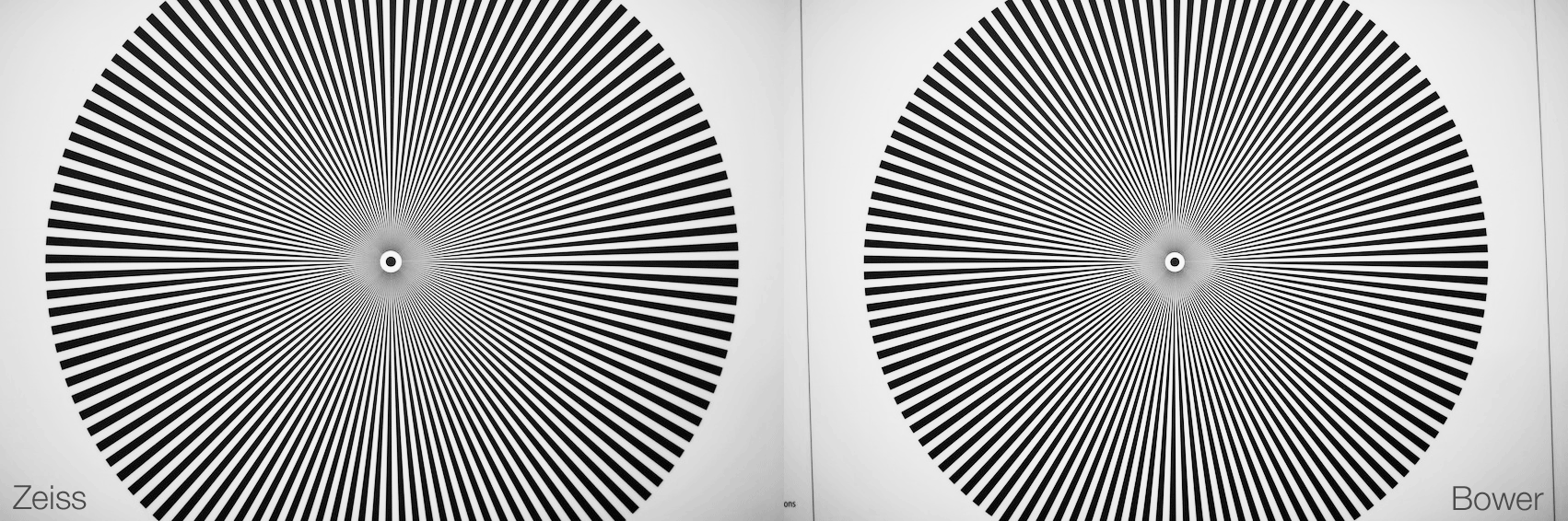
If you frequent my website, you are surely familiar with the Zeiss ZF.2 line of lenses. They are considered the high end of DSLR lenses in terms of quality and price, unrivaled german engineering. But recently, a new crop of cheap-o lenses have made their way across the ocean and are really giving Zeiss a run for it’s money. Shooters originally became aware of the cheap new opticsin the form of an 85mm f/1.4 high speed prime. Samyang, a Korean CCTV lens manufacturer realized that their low light security camera lenses could easily be re-mounted and produced with common DSLR mounts such as Nikon F and Canon Eos. The 85mm f/1.4 that they produced was a simple solution to a new age problem, a basic manual focus, manual aperture lens with no funny acronyms or clever buttons, in fact, very similar to Zeiss’ ZF.2 line of lenses. Samyang went on to produce more focal lengths but didn’t have an outlet for the US or EU market. A simple badge and name change allowed Samyang to sell their new lenses as Rokinon and Bower lenses. Several clients contacted me asking if I had seen or used the Samyang lenses to which I replied, “Where do I buy one?”. Eventually a client sent me the Bower version of the recently released 35mm f/1.4 high speed lens to receive our Cine-Mod. He wanted to use the Bower 35mm f/1.4 Canon Eos mount on his Sony F3, but it needed a gear for follow focus, a common 80mm front, and the click-stops taken out of the iris. I told him I hadn’t modified one of those before but I would be glad to give it a go. Sure enough, the Cine-Mod went great. The lens works very well as a motion picture lens once Cine-Modded. This got me thinking, how good? I started to compare it to the recently released Zeiss 35mm f/1.4 ZF.2. At first glance, the obvious differences are the materials used. The Bower lens uses a plastic exterior shell, aluminum core, and various materials for the internal mechanical components. The Zeiss uses nothing but high quality aluminum and steel components which make is a solid beast of a lens. Easily the heaviest of the ZF.2 series, the 35mm f/1.4 ZF.2 weighs in at 1lb, 14.7oz. whereas the Bower and it’s plastic shell weigh in at 1lb, 8.7oz. Not a huge difference, but certainly noticeable, in hand. Another minor difference is the length of each lens. The Bower is longer by about half an inch, probably because of an additional shell that keeps the Bower a constant length, internal focus. The Zeiss is slightly shorter but extends to about the same length at minimum focus.
Now onto the juicy stuff. A price tag of $1,843 makes the Zeiss lens a hefty purchase for a budget shooter, whereas the Bower totes a relatively tiny price tag of only $500. One would assume the difference in image quality would be reflected in the generous price gap. You’d be surprised… The resolution is so similar, it’s difficult to tell the difference without really scrutinizing the results. Also, note the difference in field of view. The Bower lens has a field of view more similar to that of a 30mm when the Zeiss maintains a 35mm field of view. Not a big deal, but something to be aware of.
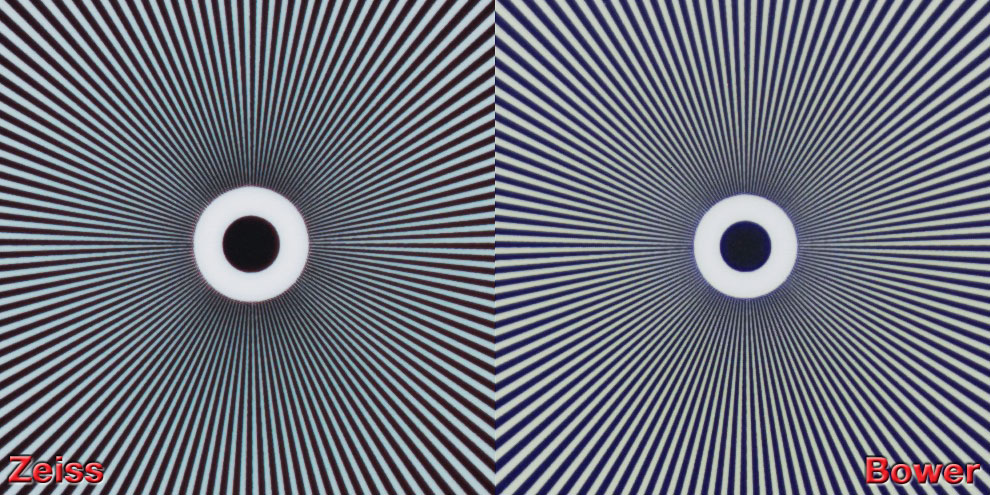
The next sample is a center crop of the two full images. I converted the larger images to black and white but left the cropped image in full color to show the chromatic aberration and purple fringing exhibited by each lens. There really isn’t much CA or fringing on the Zeiss but a moderate amount on the Bower. The fringing shows up more in less ideal conditions. The bower flares quite a bit when pointed at bright highlights. The Zeiss controls the light a lot better, presumably due to their proprietary T* coating. I threw the two lenses up on some test equipment and found some other flaws with the Bower. The focus marks on the Bower seem to be placed sort of carelessly. The infinity mark didn’t quite line up when set on the auto collimator. The Zeiss was spot on at infinity and every other mark.There was a little bit of lost motion in the Bower, likely due to the cheaper components used in the focus. Lost motion in the focus means that when you rotate the focus scale, it takes a couple degrees to actually move the optics and effectively change your focus distance. The tight tolerances and high quality materials used in the Zeiss keep it tight and accurate. The mechanical feel of each lens is obvious. The Zeiss is bulkier and simply gives it a more professional feel. The focus rotation is about the same on each.I wish I could say the Zeiss blows the Bower out of the water. But the truth is, if I was looking for a high speed, budget 35mm, the Bower is a great option and really makes one wonder why the Zeiss is so much more expensive. Zeiss caters more toward the professional HDSLR video shooter with it’s reliability and slightly higher image quality. If you’re looking to get that low-light shot and don’t have production expense card, go with the Bower. If you are building up a high quality set or primes and want to add a fast 35mm to your set, go with the Zeiss. I think in the long run it will be worth the extra dollars. Obviously I’m partial to the Zeiss since I grew up with names like Zeiss, Leica, Angenieux, etc… But the facts are here. You decide what works for you.