
The legend of the Angenieux 12x zoom is one that most cinematographers know by heart. Since the original 24-290mm T2.8 first landed on sets, it has been the gold standard for long-range cinema zooms. With the introduction of the Optimo Ultra 12x 65, Angenieux is expanding that legacy to the medium format market in more than one sense of the word with a truly impressive bit of optical engineering that packs a massive punch.
A Proven Strategy for Large Sensors
While there is often some confusion regarding the modularity of these high-end zooms, it is important to clarify that the IRO (Interchangeable Rear Optics) technology found in the more accessible EZ series is not present here. The Optimo Ultra 12x 65 is a dedicated large-format zoom with a fixed rear group. This means you won’t be field-swapping this one to cover your Super 35 B-cam, but in exchange, you’re getting a lens optimized for the massive sensors that have become the new frontier of high-end cinematography.
This approach of modifying a core optical block with a specialized rear group to expand the image circle is a move right out of the classic Angenieux playbook. We saw it with the Optimo 28-340mm, the DP Rouge, and the Style zooms. It is a proven way to squeeze more life out of a world-class design, and by marrying this rear group to the 12x block, they have created a 46-556mm T5.6. It is an extremely practical range that effectively replaces an entire case of telephoto primes, offering a level of versatility that is indispensable for the fast-paced nature of modern sets.
Built for the Big Screen
The Optimo Ultra 12x 65 arrives at a perfect time for the industry. With its 60mm image circle, it is a fantastic companion for the current crop of large-sensor powerhouses like the Arri Alexa 65 and 265, as well as the Blackmagic Ursa Cine 17K. It is also a natural fit for the Fujifilm GFX Eterna, which has been shipping since late last year and has quickly become a favorite for those seeking that “beyond full frame” look. Providing a 12x reach on sensors of this scale is a significant technical achievement, making it a versatile tool for everything from sports to high-end narrative work.
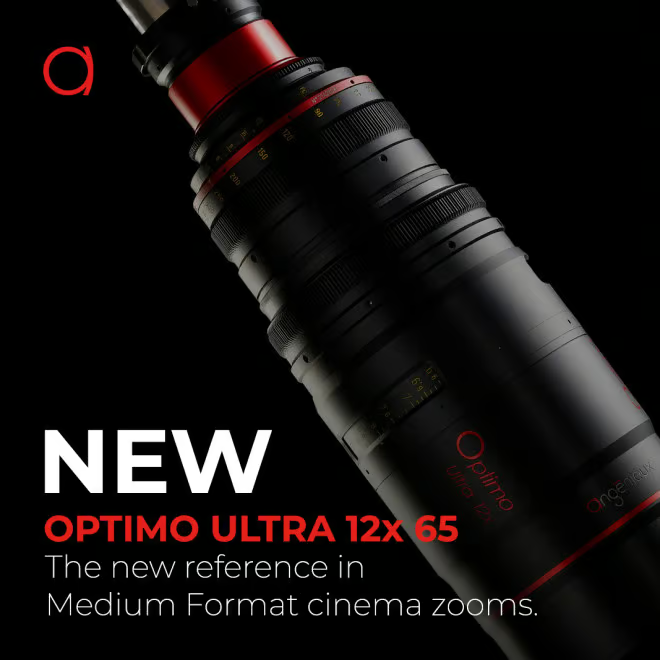
At over 28 lbs, the lens is undeniably a beast, designed for studio builds, remote heads, and substantial support systems. Regarding the mechanical design, some early pre-production photos showing black-anodized rear components raised a few eyebrows around the Duclos Lenses shop, but more recent trade show appearances have shown the lens sporting a proper stainless steel mount. It is worth noting that Angenieux explicitly describes their press imagery as “non-contractual,” so the final shipping product will likely favor the durability of stainless steel.
Curiously, the press materials make no mention of the specific mount it comes equipped with – an odd omission for a product announcement. Given its target market, it will almost certainly ship with an LPL mount as standard. If it follows Angenieux’s typical approach, it should be user-swappable, though we’re still waiting on official confirmation for that.
Design and Marketing Math
There is also a bit of a puzzle regarding the branding. While the lens is being marketed as the “Optimo 12x 65,” the technical data specifies an image circle of 60mm. It is a bit of “marketing math” that leaves one wondering where those extra five millimeters went, though 60mm is still more than enough to cover most current medium format requirements. Further complicating the name is the “12x 65” designation itself, which might cause a double-take for those coming from the broadcast world. In the land of B4-mount box lenses, a “12×65” typically describes a lens with a 12x zoom ratio and a 65mm focal length at the wide end, which would result in a 65-780mm range. In this cinematic context, however, the “65” refers strictly to the intended sensor class (65mm/Medium Format) and not the focal length. It is a subtle distinction, but one that highlights the collision of broadcast scale and cinema naming conventions.
The aperture is a native T5.6, which is the necessary trade-off for achieving such massive coverage and reach. While some might find T5.6 a bit slow, the “uncompromising performance” and signature Angenieux rendering, smooth contrast and refined cinematic texture, mean you are getting an image that matches the quality of their high-end primes. In an era where modern sensors like the Alexa 265 offer incredible clean ISO performance, a T5.6 at 556mm is a very workable reality.
Summary
The Angenieux Optimo Ultra 12x 65 is a specialized tool that brings a legendary level of flexibility to the world’s largest sensors. It follows a proven tradition of optical modification to achieve specialized coverage, now refined for the most demanding cameras on the market. While it carries the weight and the footprint of a studio workhorse, its 12x range makes it an incredibly practical solution for cinematographers who need to move quickly without sacrificing optical purity.
While official pricing was notably absent from the initial announcement, we expect it to land in line with the rest of Angenieux’s top-tier cinema zooms. If you’re ready to add this flagship zoom to your kit, you can find the Optimo Ultra 12x 65 at Duclos Lenses where we can ensure it’s calibrated and ready for the field.
As with any investment of this scale, the choice comes down to the specific needs of your workflow. And we are available to answer questions to help you decide if it is needed. If you’re ready to add this flagship zoom to your kit, you can find the Optimo Ultra 12x 65 at Duclos Lenses where we can ensure it’s calibrated and ready for the field.
As always, tech specs for my fellow lens geeks:
| Focal Length | 46-556mm |
| Aperture | T5.6 |
| Image Circle | 60mm |
| Weight | 28.2 lbs / 12.8 kg |
| Front Diameter | 162mm |
| Close Focus | 4′ 3″ / 1.3m |
| Length | 560mm / 22.05″ |
Thanks Matthew. What is the estimated list price? I am seated securely, so not to worry, as I will surely faint!
No official word on price. But I would expect it to be right around $110,000. Considering this is a somewhat specialty lens, I suspect Angenieux will produce this in a more limited production run.
Thanks Matt for keeping us posted and informed.
I assume the body of this lens (in the photo) was originally made to be an Ultra 12x FF and they rushed the promotional photos before they got a properly marked aperture ring made because it still says t/4.2! Yeah?
Yes. This is very typical of Angenieux to use a base lens and simply use a rear modifier optical group to achieve a new focal length and image circle. I agree with you that this was likely an early prototype and that’s all they had to use for promotional photos.
very observant RyRy!