 The Veydra Mini Primes were widely debated when they launched their Kickstarter campaign. Cautiously optimistic cinematographers who had been waiting for a pro-level Micro 4/3 cinema lens contributed, and exceeded the modest Kickstarter goal of $50,000 with a whopping $272,000 final pledge. After the first batches of the Mini Primes began arriving at the door steps of generous early adopters, those that didn’t contribute to the Kickstarter were… well, kicking themselves. The Veydra Mini Primes have continued to be the most professional, cinematic choice for Micro 4/3 motion picture projects. So now what…? Clearly Veydra is no one-trick-pony as they’ve just announced several new projects ahead of NAB 2015: Continue reading “With Success of Mini Primes, Veydra Lays Out Plans”
Canon Video Explains 4K Lenses
 Canon produced a short video that does a really good job of explaining what constitutes a 4K lens and reminds us of how much technology goes into the glass coming out of Canon. It really does drive home the need for high resolution lenses for todays demanding sensors. Check it out below and let me know what you think. What’s more important to you, sharpness or character? Continue reading “Canon Video Explains 4K Lenses”
P+S Technik Conveys Challenges of Rehousing Vintage Lenses
 In a recent newsletter, P+S Technik Managaing Director, Alfred Piffl, felt it prudent to bestow a bit of knowledge upon cinematographers keen on having some vintage lenses re-housed – something that I feel is necessary coming from one of the largest lens re-housing operations. There’s no doubt about it; vintage lenses have made a huge resurgence in the motion picture world. It’s not a fad that I have a solid explanation for. Perhaps it’s the fault of modern cameras being so crisp and sharp, a rather clinical look in a world of romance and beauty. Or maybe it’s just the hipster trend to use an old lens that would otherwise be off limits. Regardless of the reason, vintage lenses are being refurbished and re-housed in large numbers. But users expectations must be brought back down to earth and kept reasonable. Continue reading “P+S Technik Conveys Challenges of Rehousing Vintage Lenses”
ShareGrid – A New Approach To Equipment Rental

Rental houses have been the backbone of motion picture acquisition equipment for decades. They paved the way for professionals to get their hands on the gear they needed. The way I see it, there are a few different types: the seasoned professionals who demand nothing but Panavision gear for their projects. That’s fine… Panavision works very hard to meet the needs of their clientele and they deserve the reputation they’ve earned. Then there’s the other working pros who enjoy a slightly more progressive approach with more options. They’ll turn to popular rental houses such as Clairmont Camera, Otto Nemenz, Keslow Camera, The Camera House, and dozens more. The rental house environment has undeniable advantages for working professionals. The gear is properly maintained by qualified technicians, the prep space is an absolute dream at most rental houses, and the overall experience can make your entire production run more efficiently with a good rental house. But what if you’re looking for something a bit more budget friendly? Continue reading “ShareGrid – A New Approach To Equipment Rental”
ICE BOX – Image Circle Evaluation from Duclos Lenses
 Testing the image circle of a lens is rather simple with a test projector but it can be somewhat subjective. There isn’t always a clearly defined hard end to an image when evaluating for coverage. Sometimes a little bit of light falloff is acceptable. A natural vignette can be pleasing but it can also blend into the limit of a lens’ image and make determining maximum coverage rather difficult. I’ve spent years compiling a list of image circles based on my own subjective opinion which was met with great thanks by most – but there has always been the inevitable email or phone call from a disgruntled cinematographer who was disappointed to find that a lens clipped a fraction of a millimeter into the frame of their image despite my records. There are variables, of course, in any analog assessment such as this. Because of this, Duclos Lenses has developed a tool that records the image circle of any lens, saving a reference image for individuals such as yourself to determine to what degree the light falloff is acceptable. Continue reading “ICE BOX – Image Circle Evaluation from Duclos Lenses”
Camera Department: Continuing Education Series – Encore Presentation

A few weeks ago I was asked by friend and colleague, Seth Emmons of Leica – CW Sonderoptic, to speak at the first Camera Department: Continuing Education Series. The event was offer exclusively to Local 600 members for three days with a different group each day. We covered topics ranging from how to properly clean glass – what chemicals to use and what not to use – to simple infinity focus checking. It was great fun and a pleasure meeting some of our industries working professionals. The event was a sponsored by CW Sonderoptic as well as Camadeus Film Technologies who had some goodies on display from brands such as Leica, C-Motion, and Gecko-Cam. Back by popular demand, the Camera Department: Continuing Education Series is opening up the next event to everyone this time for a very reasonable fee. Continue reading “Camera Department: Continuing Education Series – Encore Presentation”
Canon CN-E Primes – An In-Depth Look
 Canon announced their CN-E Primes back in 2011 with only a 24, 50, and 85mm. They quickly added the 14, 35, and 135mm to the line-up providing cinematographers an set of six lenses from 14 through 135mm. The lenses are plenty sharp and built rather well. Duclos Lenses saw the potential of these primes and took action. In this post, we’re going to dive into what makes the Canon CN-E Primes such great lenses and why Duclos Lenses chose these particular lenses for modification to PL mount. Continue reading “Canon CN-E Primes – An In-Depth Look”
Veydra, First To Offer M4/3 Cinema Primes
 Until now, shooting cinema on a Micro 4/3 camera meant you were using still photo lenses or lenses that were adapted or modified for motion picture use. The new Veydra Mini Primes are the first lenses to be built from the ground up as motion picture cinema lenses specifically for the Micro 4/3 platform. Considering the super shallow flange depth and tiny sensor size of Micro 4/3, the options for adapting lenses is almost limitless. But what if you’re using a Blackmagic or Panasonic GH4 in a professional environment and don’t have time to fiddle with adapters or down-time for vintage lens repair? The Veydra Mini Primes seem to be filling a gap that no one else has with a purpose built Micro 4/3 cinema lens. Continue reading “Veydra, First To Offer M4/3 Cinema Primes”
Canon Announces Worlds Longest Cinema Zoom, 50-1000mm
 What!?! 1000mm? That’s ridiculous. Now that I have that out of the way…
The new beast
Canon announced the newest addition to the Cine-Servo line of cinema lenses, the 50-1000mm T5.0-8.9 Ultra-Telephoto Zoom. This makes just about every other telephoto cinema zoom look like a toy. The lens will feature a built in 1.5x extender that will bump your focal length to a 75-1500mm and all the other bells and whistles you could ask for. Quite possibly the most impressive feat of this new super zoom is it’s size and weight coming in at a very manageable 15.9″ length and just over 14 lbs. – that’s 10lbs lighter than a 24-290mm Optimo! Continue reading “Canon Announces Worlds Longest Cinema Zoom, 50-1000mm”
Planet5D Takes a Closer Look at Voigtlander Noktons
 Micro 4/3 shooters are a great bunch. They realize the value of a lightweight, portable rig while still demanding 4K recording with image quality that rivals much more expensive rigs. The list of viable Micro 4/3 cinema cameras continues to grow and show son sign of slowing down. One of the only drawbacks to shooting Micro 4/3 has been the crop factor when compared to Super 35 format. Micro 4/3 requires wider lenses to achieve a field of view similar to that of a Super 35 format sensor, therefor increasing the depth of field of a given shot. For example, if you wanted to shoot a scene with a 50mm lens on Super 35 format, but with Micro 4/3, you would need to jump to a 25mm lens. This wider focal length is going to increase your depth of field and give you less bokeh. Most shooters struggle to compensate for this by using faster lenses. Continue reading “Planet5D Takes a Closer Look at Voigtlander Noktons”
Duclos Lenses Acquires UniqOptics’ Assets

Canon Cinema EOS Captures Space In 4K For New IMAX® 3D Film
 Canon is really making waves in the professional motion picture world. They have the manufacturing breadth and experience to produce some really high quality products. Professionals have been a bit slow to adopt the new system of cinema cameras and lenses – but it looks like things are picking up. …way up.
In a recent press release, Canon discusses their products being used on an upcoming IMAX film. Check out the press release below.
Continue reading “Canon Cinema EOS Captures Space In 4K For New IMAX® 3D Film”
Come Visit Duclos Lenses at the Next|Video Expo

|
|||||||||||||||||||||


Arri’s New Alexa 65 Demands Medium Format Lenses

Cinec 2014 is underway and there quite a few new products hitting the show floor. One of the most impressive and important is Arri’s new Alexa 65. That’s a 65mm sensor, which is absolutely huge when compared to Super 35, in a body not much larger than a regular Alexa. With the Amira taking care of the lighter run-n-gun style shooting, it looks like Arri is covering all the bases. Panavision has had their”top secret” medium format sensor in the works for several years but can’t seem to release a final product. I digress. This post isn’t about new cameras. If I was going to cover camera news, I’d be writing every day because let’s face it – there’s a new one just about every day. On to the lenses! Continue reading “Arri’s New Alexa 65 Demands Medium Format Lenses”
Duclos Lenses Forges One-of-a-Kind 11-16mm
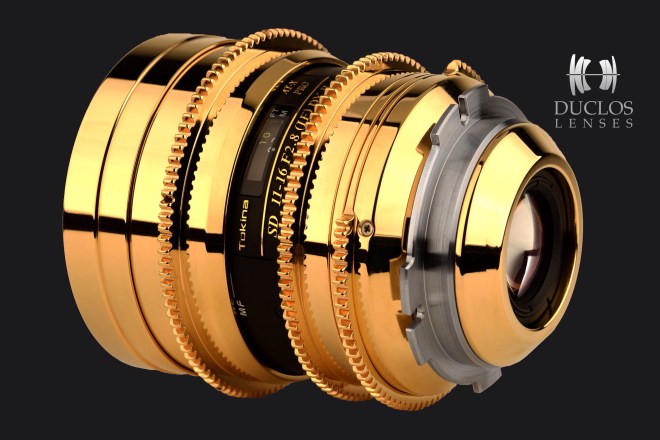 We’ve had a good deal of success with our 11-16mm conversion. So much that there have been at least half a dozen copy-cats, including Tokina themselves. Let me be clear about this – I’m well aware that Tokina was the first and only organization to make the glass itself and there wouldn’t be any conversion without them – to which I’m very grateful and respectful. What you see here is in fact a 24 Karat Gold Duclos 11-16mm. You’re probably shaking your head thinking, why… why would you do that? Well… Continue reading “Duclos Lenses Forges One-of-a-Kind 11-16mm”